In order for a decision to occur, there must be things that prove the decision tree. What I mean is, for a sustained reaction to be sustained and self-replicating, like the reproduction of DNA, there must be a set of basic variables that determine the outcome of an event. That determination is the equation of intelligence for that specific thing.
There is intelligence in an ameoba. It does not sit. It moves towards what it senses as food. You could easily program this. If food here, eat food. If not, then If food is in direction X, go to X. else move random direction. if food supply high and processed food = high then reproduce... loop back to beginning regardless of whether you reproduce or not.
Its quite simple. Each level of complexity in genetic life patterns tends to increase the level of intelligence displayed in a creature, and this tends to be exaggerated within the predator and omnivore category. I could not even begin to give you the decision matrix for a gnat, let alone a crow or a dog. The more complex the movements of the creature become, the more decisions have to be processed, and eventually you need higher level processors to aggregate that data into easier decisions, and eventually you get consciousness.
With that in mind, a tree is intelligent. A mold is intelligent. Anything that has a decision tree to make regarding its reproduction is an intelligent creature.
I think that we tend to confuse communication and brain storage capacity with intelligence. They are * degrees* of intelligence. I think once that subtlety is recognized widely our planet will actually be greener as people will think twice about what it means to be alive, but perhaps I'm just wishful thinking.
Now, there may be intelligent life in the universe that does not reproduce, but I cannot see how this would be, unless its evolution was self-contained, meaning it changed itself over into more complex forms, but the problem with this theory is that if you hit a mutational "wall" or block so to speak, you didn't reproduce, of course, there may be other things that can over come that, but the idea that reproduction drives intelligence, which we call "self-preservation", is one that I cannot overcome.
if you take a random set of amoebas, there might be one that has a mutation that adds in a simple instruction like "if no food, follow another amoeba." that seems so simple...but it VASTLY increases its chances of finding a food supply, because if that other ameoba dies it can at least chew on its bones, not that it *knows* that but thats the reality of the machine of biochemical reactions. the amoeba that has a food supply wins.
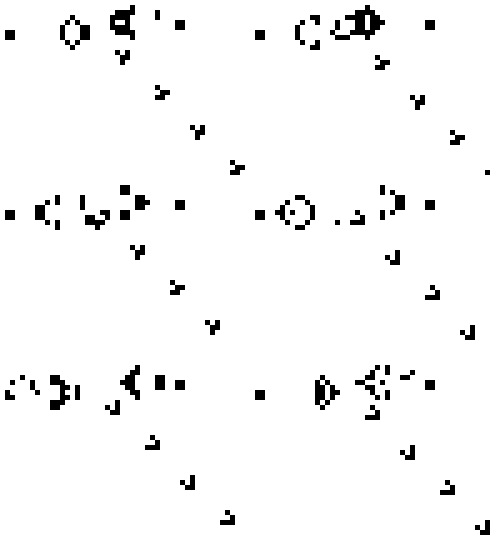
The Game of Life is a mathematical thing where you can play this game where there are simple rules, and patterns that are created with it. Its incredibly simple, but has a seriously large amount of diversity in the patterns it creates. This is a great example - a "requires two of our species" interaction and replication process - http://en.wikipedia.org/wiki/Conway%27s_Game_of_Life
With this in mind, when it comes to classifying the potential for a given species to have intelligence, we can look at a few factors in determining this:
- The complexity of its body. The more complex and coordinated and fast its movements have to be, the more likely it is to have a faster and denser nervous system.
- The size of its body in relation to its complexity. Again, the larger a creature is, the more food it needs, and the more likely it is to be picked off by bigger predators than it.
- The density of neurons. This implies a larger decision matrix and more dedicated cells to these individual trees.
- The overall ratio of nervous tissue to body mass. Again, this will have more or less impact based on #3, as a denser and larger nervous system indicate the need for the life form to have more of its resources dedicated to body coordination and decision making.
- The pressures on the life form in terms of its reproduction and life cycle. This could be:
- Scarcity of food supply
- High level of predators
- Toxic environment
- Difficult reproduction conditions (few members of the opposite sex or specific chemical/environmental conditions required).
- The age of the life form. This by itself does not determine intelligence but it must be considered that for a creature to live an incredibly long time it must be well adapted, which means a highly refined decision matrix was created, its sustainability is very superior, and predators on this planet are everywhere.
It makes me realize that any life that can be trained to make decisions outsides its instinctual decision matrix are conscious, or at least have the building blocks of it. You have to have a storage facility in order for this to occur, and this means that the decision matrix has evolved a set of conditions for making decisions based on things that may be outside what the decision matrix can handle.
In programming speak, that would be like allowing input to occur and creating a function out of it and storing it in memory for reference again later. I'm sure some type checking occurs. :)

